Week 9 Homeopathy

Discussion Questions for Tutorial:
Share your miasmatic self-analysis. • Do you consider that the key themes of the dominant miasm indicated are accurate for you?
My results were ‘psoric miasm’, which doesn’t surprise me. I recognise that symptoms of low energy or underfunctioning are part of this miasm. It fit’s with cold sores, depression, anxiety, fatigue, and worry. I see that predominantly inattentive type ADHD being a deficiency also resonates here.
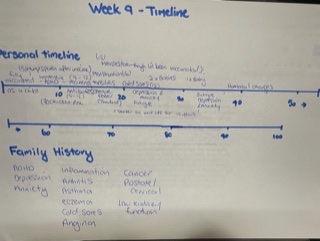
I see influences of all the miasms, Psoric, Sycotic, Tubercular, Syphilitic & Cancer Miasms in my family history. Naming ‘disease’ is only a small part of classification and treatment. Each person will present differently and their symptoms need to be treated in order of priority.
• What benefits can you see to this approach of tracing patterns of illness through lifetimes and generations?
Tracing patterns of illness on a timeline helps to see what’s happening constitutionally for the client, including their family history, and their fundamental recurring issues. The homeopathic approach will be a layered one, whereby one aspect is treated first, for example, in my chronic fatigue and depression example from last week, we can see that it is recurring through the timeline, so a remedy addressing this might have psoric features along with any other Mental and General and LSMC factors. The aim of the remedy being to stimulate the vital force enough to push back and start to heal with the right support. Continuing on I’d be looking at function, how has the body been affected. In my case, recurring antibiotic use, and dengue fever in the teen years, could have set me on the back foot in reaching more efficient functioning forward. In general, an integrated approach using an approach like homeopathy, naturopathy, tcm, ayurveda, or other holistic modalities can then improve the client’s physical and vital health.
• What disadvantages or limitations can you see to this approach of tracing patterns of illness through lifetimes and generations?
The timeline isn’t very specific. A longer consultation with the client would involve observation, talking, case taking, physical assessment, and other factors.
• What similarities and differences do you see between the homeopathic theory of miasms, and biomedical investigations into temporal disease trajectories?
Biomedical Investigations into temporal disease trajectories – Depression
I found an article by Han, X, Hou, C, Yang, H, et al., ‘Disease trajectories and mortality among individuals diagnosed with depression: a community-based cohort study in UK Biobank’. It stated:‘Patients with depression are at increased risk for a range of comorbid diseases, with, however, unclear explanations’. In a large community based cohort study, their research findings showed: ‘a diagnosis of depression in later life is associated with three distinct network-based clusters of medical conditions, indicating alterations in the cardiometabolic system, chronic status of inflammation, and tobacco abuse as key pathways to a wide range of other conditions downstream’. ‘If replicated, these pathways may constitute promising targets for the health promotion among depression patients’ (Han, X, Hou, C, Yang, H, et al 2021).(Sorry for big copy and paste chunk of text)!
Homeopathic Theory of Miasms
Miasms are associated with excess, deficiency, mutation, and other factors. They influence overall health. It’s interesting that biomedical investigations in the article identified factors in my timeline. The three factors they found related to depression were cardiometabolic problems, inflammation, and other diseases related to tobacco abuse. My grandparents and parents didn’t smoke, but I do see how depression can be comorbid with other disease diagnosis.
Psoric Miasm – Playbuzz
My test results show the psoric miasm as follows: ‘Introduced by Hahnemann, and considered by him to be the oldest miasm and root of all chronic disease. The psoric miasm’s name comes from the Hebrew word ‘tsorat’ meaning a defect and was used to describe plagues. Psora’s central idea is that of deficiency, or a lack of strength needing support. Symptoms typically occur in the skin or nervous system, and sufferers have primarily functional changes rather than pathological tissue changes or structural damage. Psoric individuals may tire easily and be restless of mind. They can be easily overwhelmed however do like to be busy. They can be chronic worriers, or suffer from phobias. Typically more chilly or lacking in vital warmth, they may have pale or unhealthy skin, digestive issues, and delayed milestones. They do however tend to live long lives due to lesser amounts of structural damage. Sulphur is known as the king of antipsoric medicines’ Playbuzz
Article reference
Han, X., Hou, C., Yang, H., Chen, W., Ying, Z., Hu, Y., Sun, Y., Qu, Y., Yang, L., Valdimarsdóttir, U. A., Zhang, W., Yang, H., Fang, F., & Song, H. (2021). Disease trajectories and mortality among individuals diagnosed with depression: a community-based cohort study in UK Biobank. Molecular psychiatry, 1–11. Advance online publication. https://doi.org/10.1038/s41380-021-01170-6