Manual Therapies (my weeks 2 & 3)
- Outline the history and practice of soft tissue therapies in Australia
Massage in Australia was used by various groups. Aboriginal groups used massage to support and heal sore injured muscles. It is still an important part of their approach to healing. The early British settlers also brought massage to Australia to address musculoskeletal problems. Early Chinese immigrants brought TuiNa, along with other types of Traditional Chinese Medicine to the Australian goldfields in the 1850s (Endeavour College).
In Melbourne hospitals in the 1850’s an Australian man, ‘Alfred Peters’ advocated for and practices soft tissue therapy / massage; and wrote a book, ‘Massage, It’s History, It’s Curative Uses, and it’s Practical Results’. This practice became popular, and in 1905, NSW, Vic, & SA had massage societies. In 1906, Alfred Peters and Dr Jon Springthorpe formed the Australian Massage Association (AMA) (Endeavour College).
In the 1970s, postmodernist thinking and holistic approaches to health (including mental health) were on the rise. From the 1980s to present day, increased awareness of personal health and wellbeing is more common. Many Australians seek massage to address musculoskeletal problems or to maintain wellbeing. Endeavour states: ‘In Australia, National standards of Vocational Education & Training (VET) have been in place since 2002. Regulated qualifications are available in’:
- Relaxation Massage
- Remedial Massage
- Reflexology
- Shiatsu
- Tui Na (Traditional Chinese Massage)
- Higher Education Level (Degree qualifications)
- Musculoskeletal Therapy
- Myotherapy
(Endeavour College).
- Compare and contrast the common forms of soft tissue therapy
There are many forms of soft tissue therapy. I have learned the various outlining functions for those listed in the notes and above. I see that remedial therapy addresses the root cause of an injury of painful musculoskeletal problem, and that it uses various Swedish massage techniques at a deeper level; as does deep tissue massage – with the aim being to heal, or remedy problems, and realign or encourage the body to realign to a more healthy state. The aim of all therapies has wellbeing and energy at the heart; where Swedish massage isn’t as in depth as the above mentioned, it is still about relaxation, movement, detoxification, and healing or realignment. I see how sports tissue massage can increase mental alertness before a game, and also soften any tight spots and lengthen and increase agility of the muscles to prevent injury; and after a game, can reduce soreness and lactic acids build up, along with provide circulation and movement to aid healing and recovery. Reflexology is unique in that it aims to directly address meridians and energy channels to specific organs. This is something that would indirectly occur in the process of all forms of soft tissue therapy.
Tutorial activities
View the video “Basic Massage Techniques” and then contribute to the Discussion Forum for this session’s topic by responding to the following Discussion Questions.
This session’s question is:
‘After you have watched the videos on massage techniques, treat yourself to a simple massage of the thigh, using effleurage and then petrissage strokes. Begin with slow effleurage strokes starting at the top of the thigh, moving down to the knee and then back up towards the top of the thigh. Continue for about 60 seconds. Vary the speed and pressure of the strokes as you go. Notice how that feels. Next perform a petrissage (kneading) technique on your thigh. Lift and gently squeeze the tissue on the top and sides of the thigh for about 60 seconds. You may want to vary the speed and intensity of the kneading technique as you go. Notice how that feels’.
Answer each of the following questions:
- Discuss how each of the two techniques felt for you.
Effleurage
‘Used to spread lubricant, warm and prepare the body for massage’ (Endeavour).
Blood came to the surface of my skin. The moisturiser is warming and my quadriceps feel like they are warming up with more blood flow and sensation
Petrissage
‘Relaxes and lengthens muscle’ (Endeavour)
I used gentle circular kneading of the skin to increase circulation and blood flow. This also helps me to identify any tender areas and use more pressure / compression to those areas while focusing on movements, gliding, kneading, techniques to the muscles.
Tapôtement
‘Provides stimulation to the nerves and local circulation of the area to which it is applied’ (Endeavour).
I’m surprised that tapotement has some pain relieving benefits and is good for keeping the blood flowing, skin moving, and probably some form of lymph drainage as the movements are quick tapping covering the surface area of the quadriceps. I used the techniques: cupping (with hands), hacking, striking, pummeling, tapping, and flicking. My muscles feel more ‘alive’ on this leg than the other.
Friction
‘Creates heat and friction to muscles and soft tissue’ (Endeavour)
I rotated my thumbs in circular motions to address smaller areas of the muscles and soft tissue. I found this creates friction and addresses sore areas. It is more focused than tapotement, and also more precise than petrissage.
Vibration
‘Potential reflex relaxation of internal organs (e.g. gastrointestinal system)’ (Endeavour).
I practiced faster cupping movements again with my hands, followed by kneading petrissage movements, and then longer effleurage strokes, and petrissage, then Tapotement to create a sense of heat energy and movement. Hopefully this promotes movement of stuck energy and promotes healthy skin, soft tissue, muscles, and circulation.
Compression
‘Relieves tension’ (Endeavour)
At the end of the massage I practiced compression. I started at the top of the quadriceps and pressed down firmly on the muscles with both hands for a few seconds, released, and then moved the compression down the muscle repeating this 4 x to the knee. This helped even distribution of blood flow perhaps and definitely relaxed the muscles.
- Compare and contrast the effects of each (effleurage and petrissage).
Effleurage is warming, soothing, and relaxing. Petrissage is the same, however it provides more movement, pressure, and friction to the soft tissue and muscles. Effleurage is a gentle practice in which the practitioner can assess the posture and see / feel where there are any knots, or postural abnormalities. Petrissage is a good way to address tension, knots, and postural problems gently and supportively. Together they’re warming, relaxing, healing, and supportive techniques in massage practices.
- Did one feel more relaxing than the other?
I have to say that both effleurage and petrissage are relaxing and soothing, however the tapotement was relaxing because I felt it was pain relieving and just what I needed to get the circulation of blood and lymph flowing after the above techniques.
- Which did you prefer? Why do you think that might be?
I didn’t have a preference. I think the whole massage sequence is relaxing, and that a combination of techniques is a holistic approach to using manual therapies.
Additional work from Session 1 cont.: The Emergence of Manual Therapy – Week 1 (additional work activities)
- Define manual therapy
Manual Therapy
Manual therapies is a term for any using touch and movement to the body’s soft tissues. Among the benefits, some are, aiding circulation and movement of lymph fluid, relieving sore muscles and assisting recovery, promoting relaxation and stress relieving effects, and moving Qi energy (in TCM) (Endeavour Lecture).
- Discuss the origins and history of manual therapy
Manual therapies can be historically traced back to 5000 BC. They’re a natural part of health and wellbeing. They haven’t always been in favour though. There’s evidence that it was used in Egypt, China, and India in 2500 BC for health and wellbeing. In Egypt as part of health practices, in China as part of Traditional Chinese Medicine, and in India as part of Ayurvedic practice. In the 5th Century BC Hippocrates prescribed massage, proper diet, exercise, rest, fresh air, and music to restore the body to a healthy state (naturalhealers.com).
Massage became popular in Rome between 200 and 100 BCE, where wealthy people employed practitioners to their homes. Massage practice was also a part of the public baths at the time. An interesting fact is that it became associated with sex abuse at the public baths because people were making it into something sexual. This gave massage a bad reputation at the time. It may or may not have been a regulated practice at the time. I think there would have been some practitioners still behaving ethically, however the news from this happening still created some mistrust around the practice of massage in society, ‘In the fourth century CE, the Roman Emperor Constantine condemned the public baths’. (naturalhealers.com).
Other periods in history knew the benefits of massage therapy as a wellbeing modality, and here we can mention some notes from the 17th-20th Centuries. History reviews tell us that from the 16th-19th Centuries Massage wasn’t a regulated or favoured modality, except in some circles, including sport. The Swedish physician Per Henrik Ling who developed the Swedish Gymnastic Movement System utilised Swedish massage to help athletes improve their performance and increase recovery times . From the 19th Century on a few other noted things occurred. In 1912 Joseph Fay, a remedial massage therapist, wrote a book, ‘Scientific Massage for Athletes’. Massage was used during world war I to help casualties nerve injury and shell shock. including the first Massage Association in Australia in 1906 AMA. In 1936 this became the Australian Physiotherapists Association. For a long time physiotherapy received more educational training and funding than massage, making it a more popular modality (naturalhealers.com).
Manual therapies are derived from practices dating back to ancient history. Both Eastern and Western cultures knew that massage could contribute to wellbeing, heal injuries, prevent and cure illness, relieve pain, reduce stress, and induce relaxation. Today, massage is a highly respected and holistic healing practice world wide (naturalhealers.com)
- Explore the various disciplines of manual therapy
There are lots of different types of manual therapies and the treatment chosen should best meet the individual needs of the client. In this week’s session I’ve read about the history of massage, and more about the many different types of manual therapies and massage available. I’ve also looked up the glossary terms as given in this week’s activity. I was surprised to learn that attunement and polarity therapies are there, practices used in Reiki and Body Synergy treatments. I can see how all forms of manual therapy are vital contributors to wellbeing.
- Understand the importance of manual therapies in today’s healthcare systems
- Preventative
- Remedial
- Stress reducing
- Maintaining wellbeing
Endeavour College
- Explain the benefits of Tactile therapies
Endeavour college: ‘Tactile therapy is concerned with treating clients through touch. This includes relaxation and therapeutic massage, as well as learning to communicate through touch whilst examining the client. Massage is the manual manipulation of the skin and muscle, and sometimes joints, to relax muscle spasms, knots, relieve tension and improve circulation’.(Endeavour College).
Week 3 Trigger Point Therapy – Discussion Questions
Is your referral pattern similar to the referral pattern images provided in the activity?
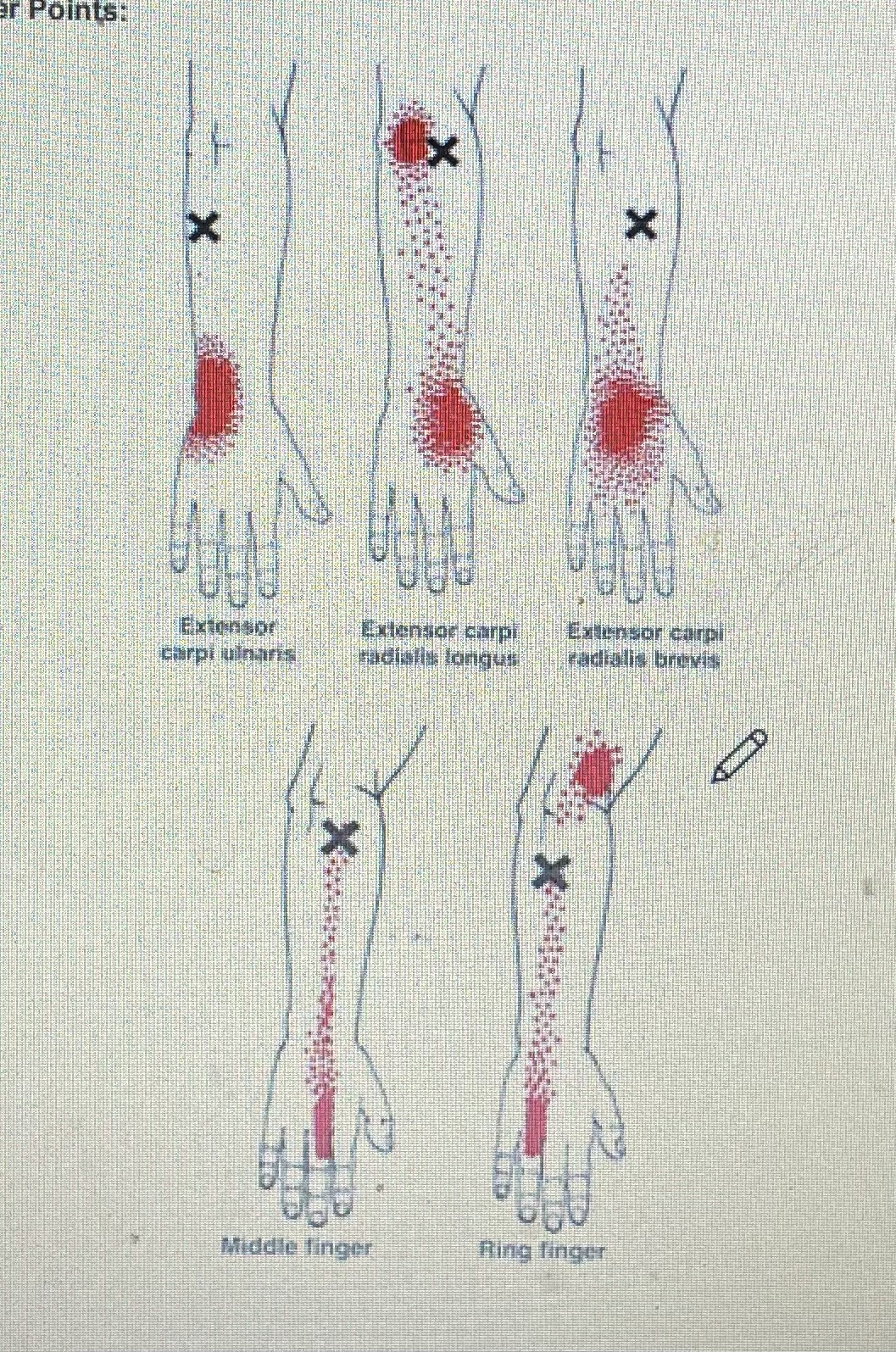
I could identify the point where ring and middle fingers connected to the outlined trigger points, however I didn’t feel any pain. When I moved both, I could feel the movement up the arm to the highlighted trigger points.
I also tried the other points, and had some sensation at the ‘extensor carpi radialis longus’ point, which radiated an energy down to the thumb, not at all in a painful way. It wasn’t a very strong sensation. The other two points I didn’t feel anything much. I noted that the muscles in my arms are fairly tense actually.
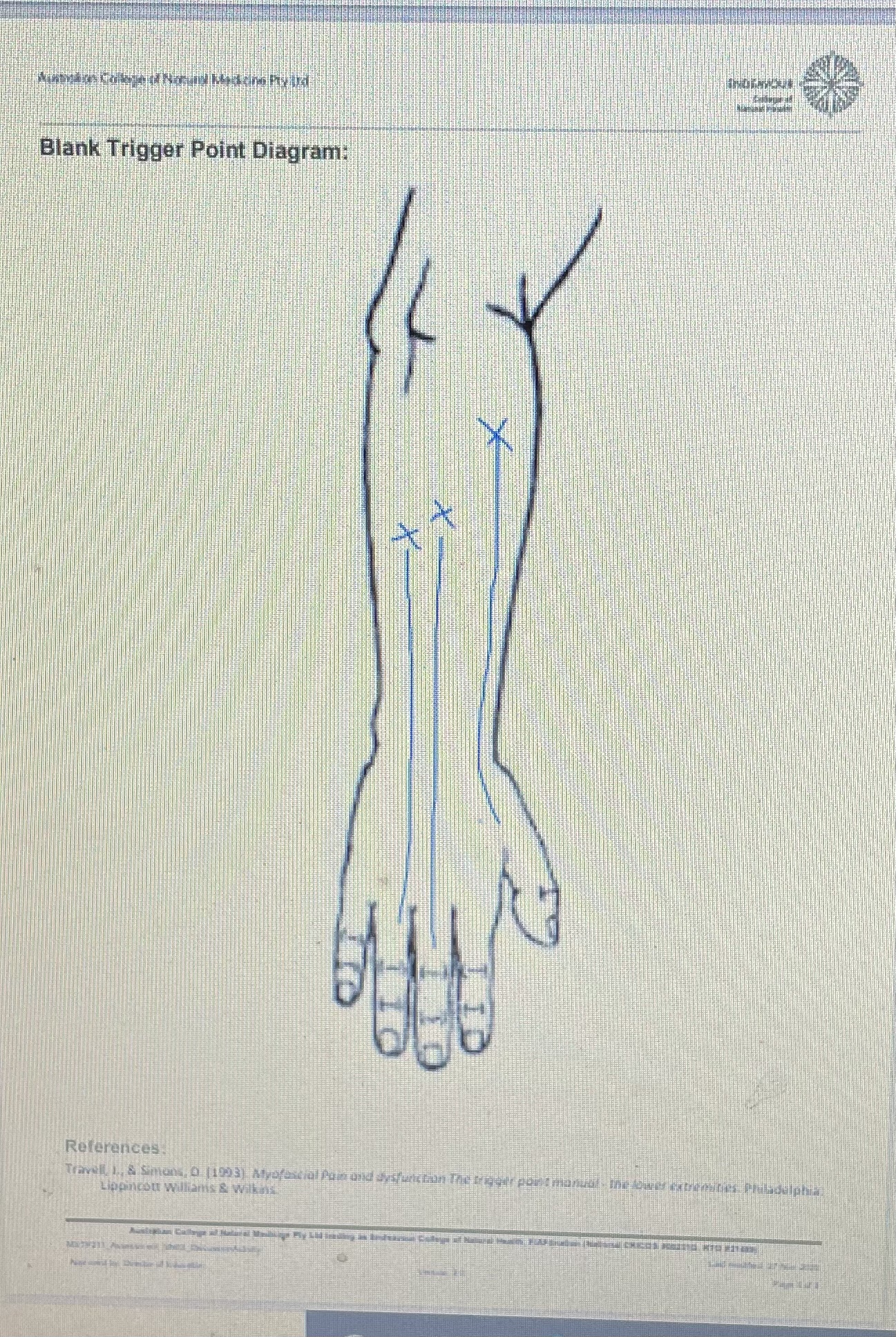
Are the images of your classmates’ referral patterns similar?
It was interesting to see the different reactions from people. A point a couple of people made was that they couldn’t feel anything (so no muscle overload or trauma) and then when they tried it on their partners, a response occurred, perhaps there is muscle trauma, or some other contributing factor?
What did the referral feel like? If it was painful, describe the type of pain. If not painful, describe the sensation.
I felt a light sensation of discomfort at the extensor carpi radialis longus point to the thumb.
Could these referral sensations become confused with other physiological or pathophysiological phenomena?
I could identify how the movement of the fingers created movement in the muscles up the arm to the outlined trigger points.