“Define and describe the goals of attentional balance, what is the meaning of maintaining mindfulness within this specific context of developing Attentional Balance”?
Attentional Balance
“Mindfulness is experienced as not holding on to the past, the future, or the newness, but relaxing into the immediacy of whatever is happening” (B. Alan Wallace)
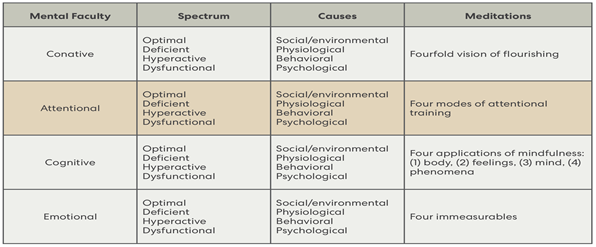
B. Allan Wallace (2018) created the Matrix of Mental Balance which outlines four Mental Faculty’s worthy of balancing to achieve attentional balance, therefore contributing to ‘Sukha’ meaning genuine wellbeing. The Mental faculties are:
- Conative
- Attentional
- Cognitive
- Emotional
B. Alan Wallace (2018) states: There are five conditions influencing the above mental faculties
- Social
- Environmental
- Physiological
- Behavioural
- Psychological
B. Alan Wallace (2018) states: there is a spectrum to measure attentional balance and the functioning of the mental faculties. This is measured by four modes of attention of which are:
Attentional balance
- Optimal
- Deficient
- Hyperactive
- Dysfunctional
There are Mindfulness practices including Meditations to assist a person to achieve optimal functioning of the Mental Faculties. B. Alan Wallace, (2018) gives four meditative practices to learn from for working with each mental faculty. For conative, he recommends, “the fourfold vision of flourishing”; for attentional – “the four modes of attentional training”; for cognitive – “the four applications of mindfulness”, which are: “1. body., 2. feelings., 3. Mind., 4. Phenomena”; and for emotional, he recommends “the four immeasurables”, “Loving kindness, compassion, empathetic joy, impartiality”. Following is a visual table.
Table 1. “Mental Matrix of Attentional Balance – B. Alan Wallace (2018)”.
Conation
“It takes no deep insight to see that the source of both our well-being and our maladies lies within our own hearts and minds. To change our experience of life we must inevitably change our hearts and minds” (B. Alan Wallace).
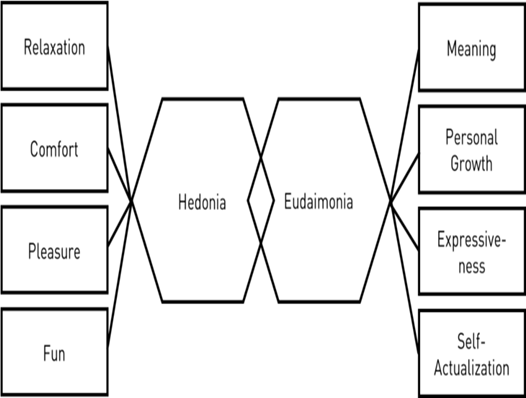
The following aspects are explored together, to gain more insight into achieving attentional balance. Firstly, Alan Wallace (2018) states there is: “Conation – the mental faculty of purpose, desire, and volition.” He might say that attentional balance here is a state of wellness in which a person can focus their desires and intentions, leading to one’s own and others wellbeing. There are two components of attentional balance here: 1. Eudemonia, and 2. Hedonia. Eudemonia is simply focus for: “well-being, meaning, personal growth, expressiveness, and self-actualisation (see table 2), (Seaborn et al, 2019).” Hedonia is simply the pursuit of attaining experiences such as: “relaxation, pleasure, fun and comfort (see table 2), (Seaborn et al, 2019).” Eudemonia is not the absence of suffering, it is part of life. Hedonia, is the experience of the good things in life that can bring us happiness, however impermanent. Cultivating attentional balance in Conation is about cultivating balance between the two (B. Alan Wallace).
B. Alan Wallace (2018) recommends the Mindfulness Practice, “The fourfold vision of flourishing”, to assist with this. It asks the person to reflect on the dimensions of human flourishing, which are the social, emotional, psychological, behavioural, environmental and spiritual aspects of life that create meaning (B. Alan Wallace, 2018).
Table 2. “The hedonic-eudaimonic dyad of psychological well-being (Seaborn et al, 2019)”.
Attention
“Again and again, counteract the agitation and turbulence of the mind, by relaxing more deeply, not by contracting the body and mind” (Alan Wallace).
The second Mental Faculty is Attention. The first way in which to learn to focus attention is by focusing on the breath. In focusing on the breath for one minute and saying silently, “Breathing in I know I’m Breathing in, and Breathing out I know I’m Breathing out (Thich Nhat Hahn)”, is to focus attention on the breath and immediate sensory experiences.
B. Alan Wallace (2005, pg. 20-24), explains that mindfulness of breathing helps to “refine, stabilise and clarify attention”. It is the precursor to “settling the mind in its natural state”, of which is followed by “awareness of awareness.”
Through relaxation, “sitting or lying down”, “stillness allows the body to remain calm and vigilant, a brings curiosity and engagement to the practice” (B. Alan Wallace, 2005). A term for this may be “Shamatha”, which translates to the sense of mental quietness and peace. There are two main faculties for training attention – they’re Mindfulness, which is the practice of focusing attention without distraction or forgetfulness; and Introspection, which is the practice of looking inwards and observing the mind and the five senses (touch, taste, sight, smell, hearing), (B. Alan Wallace, 2005).
Cognition
“Life is a flash of lightening in the dark of night, it is a brief time of tremendous potential” (B. Alan Wallace).
The third Mental Faculty is Cognition. B. Alan Wallace (2018) states: “This is the dimension of critical inquiry… for the purpose of applying mindfulness to the four domains of experience (body, feelings, mind, and phenomena).”
In B. Alan Wallace’s book “Genuine Happiness” (2005. pg. 64,65), he discusses “Insight through Mindfulness”; “To the extent that you have cultivated mindfulness through the practice of Shamatha, you’re ready to apply mindfulness in the practice of Vipasyana…the practice of Shamatha develops faculties of mindfulness and introspection…the practice of Vipasyana is an intelligent, mindful investigation into the central features of our existence.”
B. Alan Wallace (2002), suggests mindfulness practices such as:
Body
Breathing into the Abdomen (B. Alan Wallace, 2005 pg. 66-69)
Feelings
Body Scan Meditation (B. Alan Wallace, 2005 pg. 66-69) – Pay attention to the breath, feelings, and tactile sensations without judgement (pg. 84-88).
Mind
Counting the Breath Meditation (B. Alan Wallace, 2005 pg. 102-105)
Phenomena
The Fourfold Vision of Human Flourishing – focusing on conation, eudemonia, hedonia, kindness, compassion, equanimity and impartiality (B. Alan Wallace, 2018)
Emotional
“When we’re mindful, we’re deeply in touch with the present moment, our understanding of what is going on deepens, and we begin to be filled with acceptance, joy, peace, and love” (Thich Nhat Hahn)
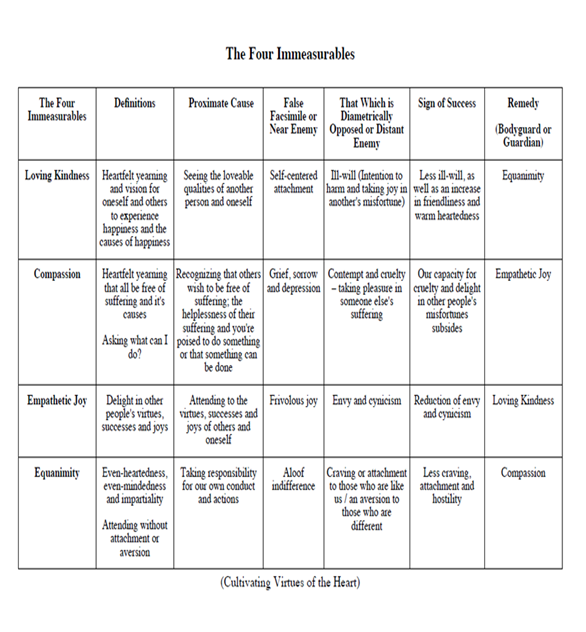
The fourth Mental Faculty is Emotion. Emotions can come and go, and they are part of everything in life. In Mindfulness an emotion can be recognised before it becomes a behaviour (B. Alan Wallace, 2018). The aim of practicing optimal Emotional balance is to cultivate “The Four Immeasurables”. They are as follows: 1. Loving-kindness, 2. Compassion, 3. Empathetic joy, 4. Impartiality (B. Alan Wallace, 2018). (See table 3 page 8).
Emotional
The table below gives the definitions for the mindful emotions to cultivate. It helps in identifying the causes of these emotions, and the signs of success in daily practices. If struggling with the practice, the potential reasons for this can be identified, and the practice remedied for better emotional balance (Alan Wallace, 2018).
Table 3 – The Four Immeasurables – (Cultivating Virtues of the Heart)
“Discuss whether there is support coming from Western psychology concerning the significance of attention in Education”
The significance of attention in Education
I believe support for mindfulness practices including relaxation in education is emerging and becoming more popular. There is an educational guide called “Rethinking Learning: A Review of Social and Emotional Learning for Education System”, by the “United Nations, Educational, Scientific, and Cultural Organisation”; which advocates that the practice of Mindfulness into learning is a must for teaching children social and emotional wellness in their early years. This guide advocates that it is necessary to prioritise Social and Emotional learning (SEL), which will also assist children to learn good cognitive and attentional skills, and therefore follow on to behavioural and psychological wellness as well – “SEL can be described as learning that allows all learners to identify and navigate emotions, practice mindful engagement and exhibit prosocial behaviour for human flourishing towards a peaceful and sustainable planet (Rethinking Learning 2020).”
There are increasing studies that show that Mindfulness works in the cultivation of attention skills. The research by Zenner et al (2014), “Mindfulness-based interventions in schools—a systematic review and meta-analysis”, concluded that mindfulness-based interventions for children and youths are able to increase cognitive capacity of attending and learning, and that results further improved where families implemented more mindfulness practices to follow up with at home.The study recommends that further research in schools is carried out to measure improvements to learning various skills and resilience.
The development and cultivation of attention skills in western psychology
The book “Teaching Mindfulness Skills to Clients” by Dunkley & Stanton (2014), discusses the efficacy of mindfulness practices and the broad range of uses for developing attentional skills, increased focus, concentration, and wellness in a diverse range of situations and settings (Dunkley & Stanton, 2014). There are therapies including Cognitive Behavioural Therapy and Dialectical Behavioural Therapy, which use attentional skills to achieve clarity, calm, and relaxation. The precursors to these therapies are insight and acceptance which are aimed at creating relaxation and attentional balance (Cheng-Kar & Tian Po , 2012). The concept of relaxation as a precursor for attentional balance is arguably not as clear in western psychology as in emerging concepts in mindfulness practices.
“Discuss whether a sustainable level of attention could be cultivated without a basis of relaxation. Offer your opinion on the following empirical question posed by Shapiro and Wallace (2006, p.696): Is focused attention opposed to relaxation or is relaxation a fundamental prerequisite to states of focused attention that can be maintained for long periods without exhaustion.”
From learning the Matrix of Mental Balance, the theme of relaxation as a prerequisite to focused states of attention, is a thread that is emphasised throughout. When learning about the mental faculties, for example, to have optimal functioning across the four mental faculties, there is a cultivation of practices which require breath work and meditations to achieve good mindfulness and introspection practices – Shamatha and Vipasyana, peace, calm, stillness, and focus respectively (B. Alan Wallace). If the body is under stress, it isn’t able to truly achieve attentional balance without the former more relaxed states of being. An example might be, if a person wants to run a triathlon, they need to train for this with good practices, so that they’re relaxed enough when running to succeed in achieving their goal to reach the finish line. All in all both relaxation and focus of attention are required in achieving attentional balance.
References
Cheng-Kar , P., & Tian Po , S. (2012). From Mindfulness to Meta-mindfulness: Further Integration of Meta-mindfulness Concept and Strategies into Cognitive-Behavioral Therapy (Vol. 3). Journal of Mindfulness.
Dryden, W., & Still, A. (2006). Historical Aspects of Mindfulness and Self Acceptance in Psychotherapy (Vol. 24). Journal of Rational-Emotive and Cognitive-Behaviour Therapy. doi:https://link.springer.com/article/10.1007/s10942-006-0026-1
Dunkley, C., & Stanton, M. (2014). Teaching Clients to Use Mindfulness Skills: A Practical Guide. Routledge.
Educate, Inspire, Change. (2022). 29 Mind-Blowing Thich Nhat Hanh Quotes That’ll Enlighten You. EducateInspireChange.Org.
Mindfulness in Schools Project. (2022). What is Mindfulness. doi:https://mindfulnessinschools.org/
Sheinman, N., & Russo – Netzer, P. (2021). Mindfulness in Education: Insights Towards an Integrative Paradigm. doi:https://link.springer.com/chapter/10.1007/978-3-030-64537-3_24
Thich Nhat Hanh . (n.d.). Breathing in I know I’m Breathing in. Plum Village.
United Nations, Educational, Scientific, and Cultural Organisation. (2020). Rethinking Learning: A Review of Social and Emotional Learning for Education Systems. Mahatma Ghandi Institute of Education for Peace and Sustainable Development.
Wallace, B Alan. (2022). B. Alan Wallace > Quotes. GoodReads.Com.
Wallace, B. A. (2005). Genuine Happiness. John Wiley & Sons, Inc.
Wallace, B. A. (2013). The Four Immeasurables. Penguin.
Zenner, C., Herrnleben – Kurz, S., & Walach, H. (2014). Mindfulness-based interventions in schools—a systematic review and meta-analysis (Vol. 5). Frontiers in Psychology. doi:10.3389/fpsyg.2014.00603