Homeopathy (my third week).
Discussion Questions for Tutorial:
Post a summary of your case analysis to the session forum, with any relevant aspects you’d like to highlight.
• Which classification system have you used?
Homeo Books.Com gives the components of a symptom, and there are others notes from Homeopaths including:
- Kent
- Hahnemann
- Vithoulkas
- Sankaran
I categorised the components of my symptoms however I could look at it from another perspective, so I’ve decided to try Sankaran’s 7th level perspective from this week’s lectures, as I’ve read his book ‘the Spirit of Homeopathy’..
From memory, I think that Sankaran has an expanded symptom picture not limited to, but including, animal, plant, and mineral kingdoms, sensations, and miasms. In the link below he describes the evolution of his approach to include classical and contemporary homeopathy with a synergistic approach, which is an interesting read.
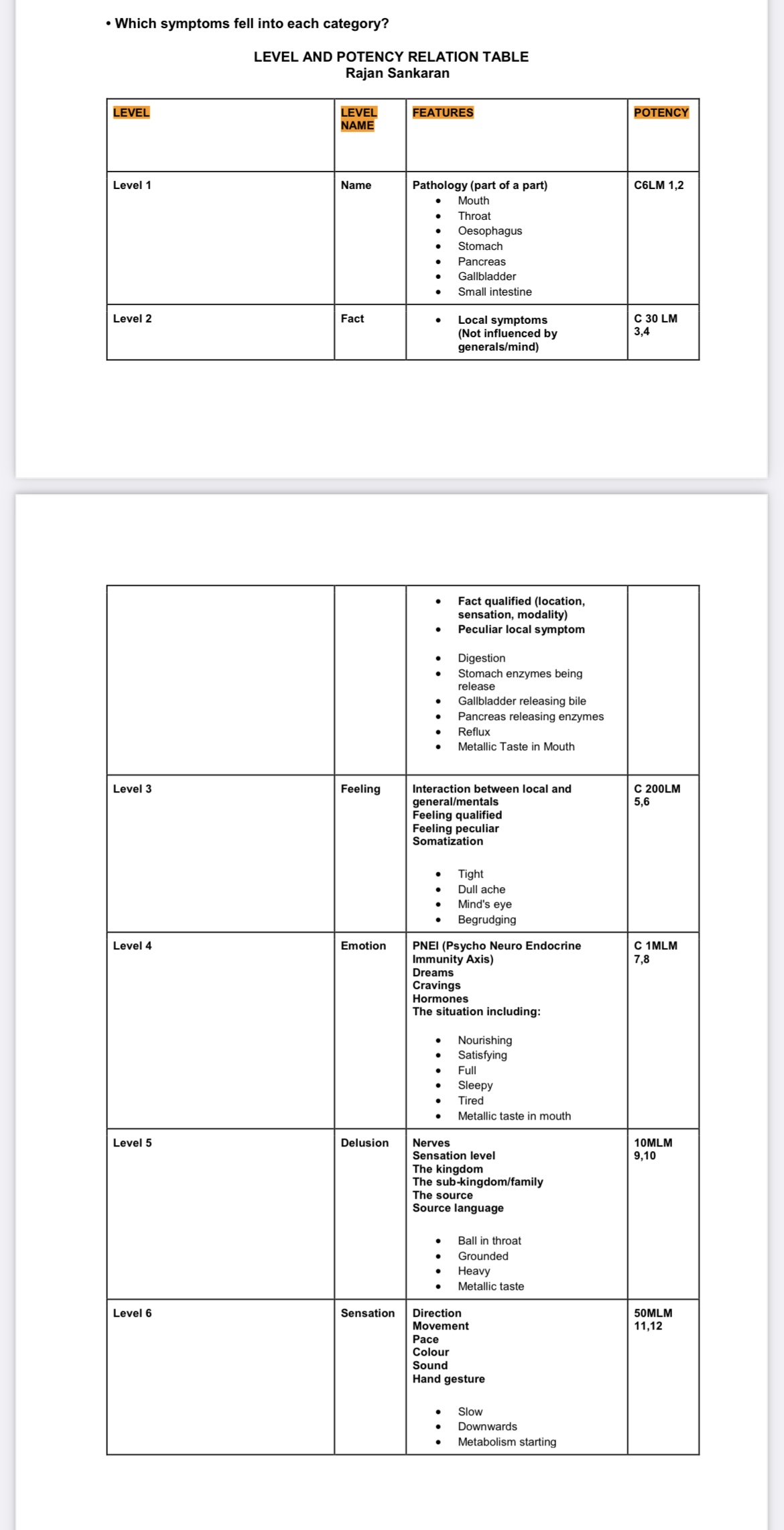
I’m not clear on all of it, but for interest’s sake and an extra challenge, I had a go filling in what I can from my experiment into the table of the 7 levels given in this article. It outlines the 7 levels talked about in the lectures.
Link: Dr. Rajan Sankaran https://hpathy.com/homeopathy-interviews/dr-rajan-sankaran/
• Which symptoms fell into each category?
LEVEL AND POTENCY RELATION TABLE
Rajan Sankaran – See link above for table example.
LEVEL AND POTENCY RELATION TABLE
Rajan Sankaran Method
• How did the classification system affect your understanding of what might be important to a homeopath when they are analysing such a case?
I see all factors are important when analysing a case. As the lecture conveyed, it is not so much the symptoms that come with various illnesses, e.g. fever, nausea, sore throat, cough, runny nose, rash, constipation, diarrhoea, swelling, pain, mobility, energy levels, etc. Rather it is the Peculiar, Strange, Rare, and Particular – mental, physical, and emotional components of a disease that will point towards the most efficient remedy.
• Can you link your analysis back to homeopathic principles and philosophy?
Yes, It makes sense that I had some of the reactions above. If I had remedies, perhaps one that would match Level 5 ‘delusion’ e.g. ‘ball in throat, and grounded’ would help identify the particulars of a remedy for me. Also, ‘begrudging sensation and emotion’ and ‘awareness ‘mind’s eye’, might match levels 3 and levels 7 respectively? So any remedies with those in the symptom picture would be interesting to look at!
• Contrast this with the perspective of another therapeutic system that you are familiar with. What is similar and what is different?
I’m studying an introduction to traditional Chinese medicine along with this course. I haven’t learned much about this previously. The definitions of Yin, Yang, and Qi, are similar to the definition of the Vital Force in Homeopathy. They’re both the energy of life and constitutions, and they’re both the observation and the remedy too. Both therapeutic systems adjust these energies to bring about healing.
The differences are that they have their own unique symptom classifications, and treatments. For wellbeing the wisdom and knowledge of both practices are applied differently. Both are based on centuries of knowledge learning and evidence, and both are evolving in their practice and distribution around the world as more people are successfully utilising these practices for wellbeing.
Revision Questions / Activities
1. For what reason do homeopaths focus on characteristic symptoms rather than common symptoms?
Common symptoms might be seen in all types of diseases, for example fever, nausea, pain, vomiting, diarrhoea, mobility issues, fatigue, rashes, sore throat, but the real defining cause of disease and remedy can be identified in the vital force of a person, and in the characteristic symptom patterns of the illness.
2. For what reason do biomedical practitioners focus on common symptoms rather than characteristic symptoms?
Biomedical practitioners generally focus on common symptoms to see the diagnosis of the disease, for example Measles is normally in-arguably Measles because of the common defining symptoms that identify it as, that. The difference with biomedical practitioners and homeopathic practitioners is that the later will record things like family Miasms (history), sensations, mental, physical, and emotional responses, and other strange, rare, or peculiar occurrences, and will actually give a remedy to treat not just the measles but the other symptoms as well.
This might mean that the Measles is the main presentation, and it may very well override all other disease patterns in this time, but through the process of this disease the homeopathic doctor will be getting to know the patient’s constitution and how this disease affects the patient and will be recording this to form a holistic understanding. The symptoms will still be treated with the biomedical model integratively if the patient requires urgent medical intervention for management of acute symptoms.
The difference is in the approach to how the disease and the patient are perceived. An interesting perspective from Hahnemann is that childhood illnesses like Measles actually serve to strengthen the constitution by throwing Miasmatic (inherited weakness) from internal organs, outwards, through the channels of the skin. Like Herring’s law of cure; healing always takes place from inwards to outwards, and from above to downward. Today vaccination doesn’t allow the full force of this illness, thus suppressing what may have otherwise been a healthy expression of the Vital force in childhood, when the constitution has the energy to throw off such weaknesses. The reference for this theory is from one of Hahnemann’s writings, however I remember reading it in a book, and I’m not sure which one – ‘the organ of medicine’?
3. How does a homeopath identify if a treatment is having a positive or a negative effect on the
Individual?
Hering’s law of cure states that an illness heals from inwards to outwards, and from above in a downwards direction. If a patient is receiving treatment and previous symptoms return in the reverse order that they appeared, this can be seen as a symptom picture that is resolving. Another term for this is ‘healing crisis’, which wouldn’t see worsening of symptoms, just a reverse order of symptoms that are easily managed and that go away as the symptom picture resolves. In contrast, a disease crisis might be experienced by more internalised disruption to the constitution, whereby the Vital force doesn’t have enough energy to throw out the disturbance, so rather it becomes more deeply ingrained in the symptom picture (Endeavour Lecture).